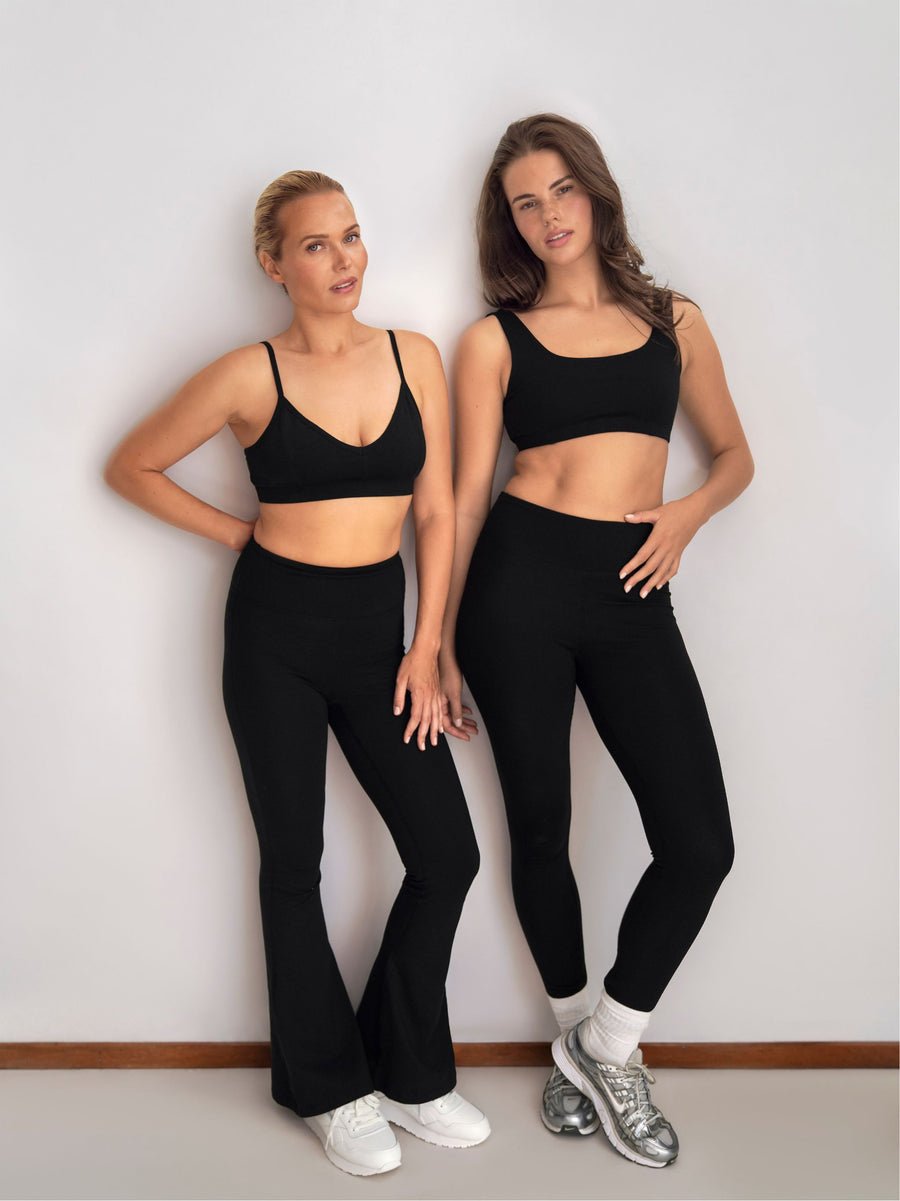
Triclosan in Activewear: The Antibacterial Agent That Disrupts Your Hormones
Triclosan is an antimicrobial agent that was used for years in soaps, toothpaste, and activewear due to its antibacterial properties. However, triclosan has now been found to be an endocrine-disrupting chemical that contributes to antibiotic resistance, allergies, and environmental damage. Its use in hand soap and cosmetics is banned in many countries, but it is still permitted in textiles and activewear. This means you might be wearing a substance harmful to your health and the planet daily.
What is triclosan?
Triclosan (TCS) is a synthetic antimicrobial agent that has been used in consumer products since the 1970s. It kills bacteria by blocking an enzyme essential for fatty acid synthesis, preventing bacteria from multiplying.[1] It was widely used in hand soaps, toothpastes, cosmetics, cleaning products, and even in kitchen utensils and textiles. Activewear is no exception.
The chemical structure of triclosan closely resembles that of dioxins and PCBs – both known environmental toxins – which raised the first warning signs about its potential toxicity.[2]
Where can you find triclosan?
Although triclosan is increasingly being banned, it is still found in:
Textiles and activewear: T-shirts, socks, yoga leggings, sports bras, and shoes, often with claims like "antibacterial" or "odor-free." A 2016 study found triclosan in 76% of the tested "antibacterial" activewear.[3]
Personal care products: hand soap, body wash, toothpaste, mouthwashes, deodorants, shaving cream, makeup, and cosmetics.[4] Research shows that triclosan from these products is rapidly absorbed through the skin and is detectable in urine within hours.[5]
Household products: cleaning products, cutting boards, plastic containers, toys, carpets, and mattresses.[6]
Medical use: surgical scrubs, catheters, sutures, and wound dressings.[1]
Environment and food chain: triclosan is found in wastewater, rivers, seawater, sediment, agricultural soils, and even in fish, milk, and honey.[7] A study found triclosan in 97% of pregnant women tested in the US.[8]
Why is triclosan in activewear?
Brands add triclosan to activewear for three reasons:
Antibacterial action: prevents the growth of odor-causing bacteria. But research shows that triclosan-treated clothing is barely more effective than untreated clothing after multiple washes, as the active substance leaches out.[9]
Marketing value: "antibacterial" sounds high-tech and hygienic. This often justifies a higher price, despite the lack of long-term effectiveness.
Perception of durability: clothing seems to stay fresh longer and needs to be washed less often. Ironically, triclosan actually contributes to environmental pollution.
However, with every wash, some triclosan leaches out of the fibers and enters the environment. At the same time, it sits directly against your skin for hours, where it is absorbed.[10]
Health risks
Endocrine-disrupting effects
Triclosan is an endocrine disruptor. In animal studies, thyroid function disruption and changes in sex hormones were demonstrated.[11] A meta-analysis of 1,312 male participants found that higher triclosan exposure was associated with reduced sperm concentration and motility.[12]
In rats, triclosan exposure led to reduced testosterone production and impaired reproduction.[13] Human cell studies show that triclosan can activate the estrogen receptor, disrupting hormone-sensitive processes.[14]
Bacterial resistance
Long-term use of triclosan can make bacteria resistant – not only to triclosan but also to antibiotics. This contributes to the global resistance problem.[15] Research shows that triclosan-resistant bacteria develop cross-resistance to clinically important antibiotics such as ciprofloxacin.[16]
Allergies and skin problems
Children with higher triclosan levels in their bodies are up to 23% more likely to have eczema, and prenatal exposure doubled the risk of hay fever.[17] A study of 860 children found that increased urinary triclosan levels were associated with a significantly higher prevalence of allergic sensitization.[18]
Liver and kidney tumors in animal studies
In mice, long-term exposure caused liver fibrosis and tumors.[19] An 18-month study showed that triclosan promoted hepatocellular carcinoma through dysregulation of bile acid metabolism and the microbiome.[20]
Environmental impact
Every wash of triclosan-treated textiles partly leaches the substance. Wastewater treatment plants do not remove it completely, allowing triclosan to enter rivers and oceans. There, it harms algae, fish, and bottom-dwelling organisms.[7] Studies show that triclosan is toxic to water fleas (Daphnia magna) at concentrations regularly found in surface water.[21]
Triclosan is also found in sludge applied to agricultural land, allowing it to enter the food chain. Research found triclosan residues in 94% of tested sludge samples from wastewater treatment plants.[22]
Maximum permissible amounts
EU (cosmetics): maximum 0.3% in toothpaste, hand soap, deodorant, makeup, and personal care products. For mouthwash, it is 0.2%.[23]
Canada: maximum 0.3% in cosmetics and oral hygiene products.[24]
US: banned in hand and body washes since 2017, but sometimes still permitted in toothpaste.[4]
Activewear: falls under biocide legislation in the EU. There are no fixed limits. Manufacturers only need to prove that triclosan is "safe" – so it is not banned in clothing.
Is triclosan in activewear tested?
Laboratories can measure triclosan in textiles via GC-MS (gas chromatography-mass spectrometry). OEKO-TEX® prohibits triclosan; clothing with this label should be triclosan-free.[25] GOTS (Global Organic Textile Standard) also prohibits all biocides, including triclosan, throughout the entire production process.
However, regulations do not mandate standard tests for textiles, so consumers often don't know if their clothing contains triclosan. A 2019 consumer survey found that only 12% of brands selling "antibacterial" activewear were transparent about which chemicals were used.[26]
How GOTS and OEKO-TEX protect against triclosan
Triclosan – the antibacterial substance we just discussed – is exactly the type of biocide that GOTS and OEKO-TEX Standard 100 protect against. These certifications offer different but complementary protection.
| Aspect | GOTS | OEKO-TEX 100 |
|---|---|---|
| Triclosan in production | Completely prohibited. Triclosan and all other biocides may not be used in antibacterial treatments or finishes. | Triclosan is prohibited in certified products. Strict detection limit: not detectable in the final product. |
| Antibacterial coatings | Only natural, non-toxic alternatives allowed (such as silver in controlled quantities, but this is also critically reviewed). | Tests for the presence of triclosan and other prohibited biocides. Products with detectable levels are not certified. |
| Odor control | Natural fibers like organic cotton naturally regulate bacterial growth without requiring chemical treatment. | Alternative odor control must meet strict toxicity standards. Triclosan explicitly excluded. |
| Protection strategy | Preventive: biocides like triclosan must not be used throughout the entire production process. | Controlling: final product is tested to rule out triclosan residues. |
The difference in approach: GOTS completely prohibits triclosan and other biocides during the production process, while OEKO-TEX 100 tests the final product to guarantee that triclosan residues are not detectable. For organic cotton activewear with both certifications, this means absolute certainty: no triclosan during production and a tested final product.
Paradox: banned in soap, not in clothing
The FDA banned triclosan in hand soap because ordinary soap and water are just as effective, and triclosan posed too many risks.[4] But in activewear, which is worn directly on the skin for hours, it is still permitted – despite the fact that skin absorption is higher with activewear due to sweat, heat, and prolonged contact.
This is a curious double standard: the product you use for a few seconds (soap) is banned, but the garment you wear for hours (activewear) can still contain it.
Conclusion
Triclosan seems like a clever innovation for "fresh activewear," but in reality, it is an invisible threat. It disrupts hormones, promotes resistance, causes allergies, and pollutes ecosystems. The science is clear: the risks do not outweigh the limited benefits.
At NOHI NATURAL, we therefore consciously choose GOTS-certified organic cotton without bactericidal coatings or biocides. Natural cotton naturally regulates bacterial growth through its breathable properties and moisture management – no chemical tricks needed. Because true health begins with what you wear and the choices you make for the earth.
View sources
- Yueh, M.F. & Tukey, R.H. (2016). Triclosan: A widespread environmental toxicant with many biological effects. Annual Review of Pharmacology and Toxicology, 56:251-272. pmc.ncbi.nlm.nih.gov/PMC4774862
- Dann, A.B. & Hontela, A. (2011). Triclosan: environmental exposure, toxicity and mechanisms of action. Journal of Applied Toxicology, 31(4):285-311. pubmed.ncbi.nlm.nih.gov/21462230
- Lassen, T.H. et al. (2016). Antimicrobial agents in consumer products: Prevalence and human exposure. Environment International. pubmed.ncbi.nlm.nih.gov/26851498
- US FDA. (2016). FDA issues final rule on safety and effectiveness of antibacterial soaps. fda.gov/antibacterial-soap
- Sandborgh-Englund, G. et al. (2006). Pharmacokinetics of triclosan following oral ingestion in humans. Journal of Toxicology and Environmental Health, 69(20):1861-1873. pubmed.ncbi.nlm.nih.gov/16952905
- US EPA. (2024). Triclosan – Ingredients Used in Pesticide Products. epa.gov/triclosan
- Dhillon, G.S. et al. (2015). Triclosan: Current status, occurrence, environmental risks and bioaccumulation potential. International Journal of Environmental Research and Public Health. researchgate.net/277963245
- Calafat, A.M. et al. (2008). Urinary concentrations of triclosan in the U.S. population: 2003-2004. Environmental Health Perspectives, 116(3):303-307. pubmed.ncbi.nlm.nih.gov/18335095
- Windler, L. et al. (2012). Release of titanium dioxide from textiles during washing. Environmental Science & Technology, 46(15):8181-8188. pubmed.ncbi.nlm.nih.gov/22746197
- Bertelsen, R.J. et al. (2013). Triclosan exposure and allergic sensitization in Norwegian children. Allergy, 68(1):84-91. pubmed.ncbi.nlm.nih.gov/23146048
- Paul, K.B. et al. (2010). Short-term exposure to triclosan decreases thyroxine in vivo. Toxicological Sciences, 113(2):367-379. doi:10.1093/toxsci/kfp271
- Chen, M. et al. (2013). Association of triclosan with reproductive hormones. Occupational and Environmental Medicine, 70(3):136-142. pubmed.ncbi.nlm.nih.gov/23155190
- Kumar, V. et al. (2009). Disruption of LH and testosterone by triclosan. Reproductive Toxicology, 27(2):177-185. pubmed.ncbi.nlm.nih.gov/19118620
- Henry, N.D. & Fair, P.A. (2013). Comparison of in vitro cytotoxicity, estrogenicity and anti-estrogenicity of triclosan. Journal of Applied Toxicology, 33(7):735-741. pubmed.ncbi.nlm.nih.gov/22234994
- Wired. (2016). The FDA's Ban on Antibacterial Soaps Is Bad News for Superbugs. wired.com/antibacterial-soaps-superbugs
- Yazdankhah, S.P. et al. (2006). Triclosan and antimicrobial resistance in bacteria. Microbial Drug Resistance, 12(2):83-90. pubmed.ncbi.nlm.nih.gov/16922622
- Washington Post. (2015). Children with high triclosan levels 23% more likely to have eczema. washingtonpost.com/triclosan-eczema
- Clayton, E.M. et al. (2011). Urinary bisphenol A and triclosan and allergic sensitization. Journal of Allergy and Clinical Immunology, 128(1):242-243. pubmed.ncbi.nlm.nih.gov/21489616
- Time. (2014). Common Antibacterial Compound Linked to Liver Tumors in Mice. time.com/triclosan-liver-tumors
- Yueh, M.F. et al. (2014). The commonly used antimicrobial additive triclosan is a liver tumor promoter. Proceedings of the National Academy of Sciences, 111(48):17200-17205. pubmed.ncbi.nlm.nih.gov/25404284
- Orvos, D.R. et al. (2002). Aquatic toxicity of triclosan. Environmental Toxicology and Chemistry, 21(7):1338-1349. pubmed.ncbi.nlm.nih.gov/12109732
- McAvoy, D.C. et al. (2002). Measurement of triclosan in wastewater treatment systems. Environmental Toxicology and Chemistry, 21(7):1323-1329. pubmed.ncbi.nlm.nih.gov/12109730
- EU Scientific Committee on Consumer Safety. (2020). Opinion on Triclosan. health.ec.europa.eu/sccs_o_023.pdf
- Health Canada. (2023). Cosmetic Ingredient Hotlist – Triclosan. canada.ca/cosmetic-ingredient-hotlist
- OEKO-TEX. (2024). STANDARD 100 by OEKO-TEX®. oeko-tex.com/standard-100
- Environmental Working Group. (2019). Antibacterial claims in athletic wear lack transparency. EWG Report. ewg.org